
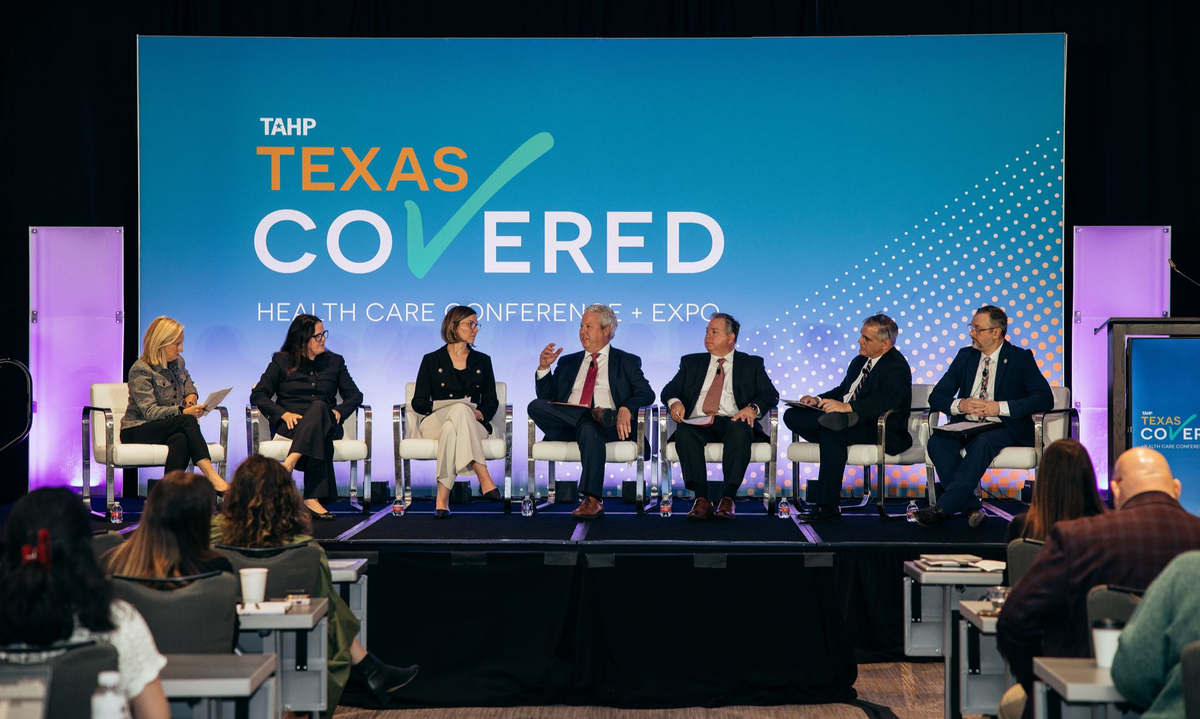
Texas Covered Kicks Off with Elections, AI, & Affordability
Complete Coverage

By: TAHP | Tuesday, November 3, 2026
Jamie Dudensing, TAHP CEO, Opens Texas Covered
- The theme for the week: Jamie welcomed attendees to Austin with a challenge: this is the room where real ideas on health care affordability turn into action.
- The moment is here: Voters want action on prices, the Governor has built an agenda around affordability, both chambers spent the interim studying it, and the Sunset Commission is reviewing HHSC now. Lawmakers return in January ready to act.
- Texas has done hard things before: The state built one of the country’s most successful Medicaid managed care programs through decades of ideas, pilots, and trial and error.
- Why it takes everyone: Every health care dollar is somebody’s paycheck, somebody’s premium, or somebody’s tax bill. Everyone wants lower costs, more access, and more choice, and you can’t have everything. That’s what makes the work hard.
- The ask: Bring the ideas that work. “If we don’t work together to bring the solutions, someone else will fill that void.”
Keynote: Buy AI That Changes Care, Not Just Paperwork
- Kicking off the day: Dr. Ziad Obermeyer, emergency physician and UC Berkeley professor, argued that chatbots and prior authorization automation are the easy part. The real payoff is AI that decides who needs a test, who needs a drug, and what each patient should pay.
- Why it matters: His research shows AI can cut utilization and improve outcomes at the same time. Plans that stop at “point solutions” risk losing to competitors built around AI from the start.
- The details:
- Smarter cardiac testing: AI would have cut two-thirds of ER cardiac tests at a Harvard hospital while catching more heart attacks in high-risk patients being sent home.
- Precision copays: Medicare patients at highest risk of heart attack were the most likely to quit their medications when prices rose. He proposed lower cost sharing for patients a drug helps most.
- A $60 device instead of an ultrasound: A consumer ECG device plus AI detects past undiagnosed heart attacks at about $2,000 per life-year, enabling screening outside the clinic.
- Payers set the market: Developers won’t build clinical AI until plans say what a working tool is worth. Name the problem, like catching heart failure a year earlier, and the accuracy you expect.
- The bottom line: Stop settling for what vendors pitch. Tell the market what health plans actually need.
Health Care on the Ballot: What Tomorrow’s Results Mean for Health Care
- Setting the stage: David Merritt, Senior Vice President of External Affairs at the Blue Cross Blue Shield Association, previewed the midterms and the 2027 health care agenda. His read: too partisan for big reform, but a few targeted fixes can pass.
- Why it matters: Affordability tops voter concerns, yet only 17% of Americans trust Congress to solve big problems. Divided government after tomorrow means health care fixes will be small and bipartisan or won’t happen.
- The details:
- Medicare for All is back: More than 60% of voters support it in the abstract. Support collapses once they hear their current coverage would be replaced.
- Fix the market, don’t replace it: Voters want the system improved. Competition delivers more choice, higher quality, and lower cost.
- Hospital billing is the root cause: Hospitals are 40% of health spending, and the same procedure can cost ten times more in a hospital than a physician office. Site-neutral payment, 340B reform, and lifting the physician-owned hospital cap all target that.
- Texas is ground zero for surprise billing abuse: Out-of-network providers and freestanding ERs are flooding the federal dispute process, winning awards five to six times market rates. Merritt called it a potential $300 billion problem.
- The bottom line: States will move faster as Washington stalls. Federal action is most likely on dispute resolution guardrails, PBM reform, and prior authorization, where both parties already agree the process is broken.
Medicaid Leadership Takes the Stage
- Where Texas Medicaid goes next: State Medicaid Director Stephanie Stephens and her leadership team walked through their priorities heading into Sunset and the 90th Session, moderated by Jami Snyder of JSN Strategies.
- What’s coming in 2027:
- Faster provider enrollment: HHSC is redesigning the enrollment system to pull in data providers already submitted elsewhere, including a direct link to Medicare’s system to fix mismatches behind about a third of provider discrepancies.
- System modernization: Ramirez called the claims and eligibility overhaul a business transformation, not an IT procurement. HHSC will test changes with plans before go-live.
- Duals expansion: The integrated Dual Eligible Special Needs Plan model expands to the remaining STAR+PLUS plans on January 1, 2027.
- Program integrity: Mayes said HHSC has started targeted reviews of plan policies in durable medical equipment and mental health rehabilitation and is planning enhanced training for plan special investigative units.
- Dr. V’s bread and butter: Van Ramshorst said service coordination matters most. Early quality review findings show kids in the Medically Dependent Children Program who were reached by their service coordinator were twice as likely to have their needs met.
- Sunset timing: The staff report comes out in November, HHSC files a formal response, and the public hearing is the first week of December.
Under the Dome: Chairmen Frank and Dean on the 90th Session
- Who was up: House Insurance Chair Jay Dean and Rep. James Frank, who leads the House’s bipartisan Health Care Affordability Caucus, sat down with TAHP’s Blake Hutson.
- What they had to say:
- It’s the prices: Frank said Texas spends 20% of its economy on health care while most developed countries spend 10%. “There is no way a knee replacement should cost $40,000.”
- Single payer is closer than you think: Frank said eight years ago he predicted Texas was ten years from single payer. Now he thinks it’s two.
- Texas out-mandates California: Dean said the state has more mandates than almost any other, and most were passed without anyone asking what they cost.
- The state exempts itself: Mandates apply to private employers but not to the state’s own plans for employees and teachers. Frank’s explanation: a fiscal note.
- Laws without enforcement: Frank compared Texas’ anti-competitive contracting law to a speed limit with no police. Consolidation means the same care at a new price.
- What they want next session:
- Mandate-lite coverage: Dean’s bill would let employers with 50 or fewer workers skip some mandates, which he estimates would cut costs 19 to 20%. The Governor has named it a priority.
- An Attorney General health care task force: Frank wants dedicated enforcement against local hospital monopolies.
- Patients with a reason to shop: Both said transparency alone won’t change behavior. People need an incentive to choose lower-cost, high-quality care.
- Their ask of health plans: Dean wants ideas, especially for rural Texas, where “there is no place to go.” Frank wants plans to align incentives with customers, because costs have outpaced wages for 30 years and someone has to bend the curve.
CEOs on the Texas Market: Where the Bets Are
- Who was up: Jamie closed Day 1 with Jim Springfield of Blue Cross Blue Shield of Texas, Charles Carter of UnitedHealthcare, Fred Turner of Curative, and Darren Johnson of Community Health Choice.
- The bets:
- Blue Cross on removing friction: Springfield said employers are more engaged than at any point in his career. Price trends are in double digits and plan-change submissions are up 50% over last year. Employers will try new designs, but members quit anything with friction.
- United on the consumer: Carter said Surest puts a certain price tag on every procedure, and close to 90% of members engage with the price through the app. When members engage regularly, their out-of-pocket costs go down.
- Curative on prevention plus AI: Turner said members who do an annual baseline visit have lower claims spend and about half the hospital days. Curative launched a “reverse deductible” product three weeks ago and a cash card that lets members pay the posted cash price at any provider with no claim to file.
- Community on price: Johnson said one unexpected cost can mean a family drops coverage. Community’s premium assistance program, backed by its parent system, has helped more than 20,000 members keep coverage.
- What gets a Texan to shop:
- Trust first: Carter said people want choice, not shopping, and a $100 to $150 difference gets their attention if they trust the comparison.
- Make it easy: Springfield said no one will spend an hour shopping. The win is showing the price difference and making the cheaper option easy to schedule.
- Just tell them the price: Turner said an MRI costs about $200 at most facilities and thousands at a few. Curative publishes the list.
- The Employer CFO is now in the room: Carter said health benefits used to sit with HR. Rising costs have put the CFO in the plan decision.
Stay updated on the latest TAHP news
Articles written by TAHP’s team of policy experts that examine the research, trends, and impact of the most important health care policy issues facing Texas and the country today.

Weekly news clips assembled by the TAHP team that highlight the top headlines from the health insurance and health care worlds, as well as important political updates.